How Hard We Talking?
Quality Runs: What They Are & Why They Matter
Before I started following properly structured running training, a lot of my runs sat in a slightly useless middle ground. They weren’t easy enough to be genuinely easy, but they also weren’t fast or structured enough to count as a proper quality session. I was basically doing a lot of accidental “quite hard” running and assuming that because I was tired afterwards, it must have been productive.
Then when I got my first coach for my second marathon, that changed quite a lot. It was the first time I really understood that harder running should have a specific purpose rather than just being a case of go out, suffer and hope for the best.
A quality run is basically a session where the pace, effort or structure has been deliberately chosen to target something specific, whether that’s improving speed, threshold or practising race pace
The important bit is that there’s a reason for doing it. Say it louder for my clients going rogue with a Wednesday afternoon interval sesh xxx.
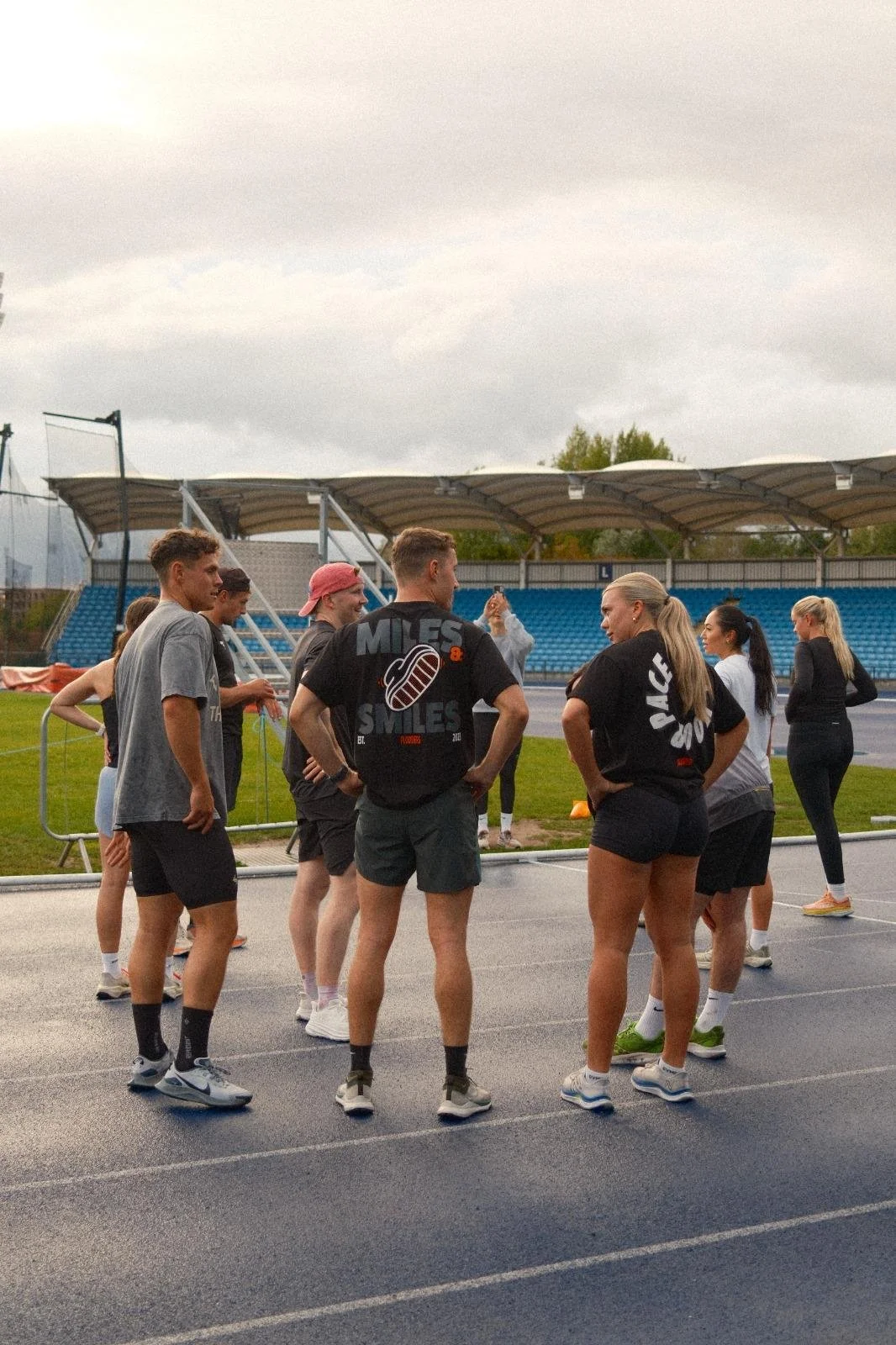
Plodders Running Club Track Night
Intervals: Learning to Put Some Speed Down
Intervals are probably what most people picture when they think of a quality session: shorter periods of faster running broken up by recovery.
The exact benefit depends on how long the reps are, how fast you run them and how much recovery you get, but they can be used to improve speed, running economy and your ability to hold faster paces more efficiently.
For example:
8 x 400m with short recovery
10 x 800m (yuck)
5 x 1K
6 x 3 minutes hard / 90 seconds easy
Shorter reps generally let you work at a faster pace, while longer reps challenge how well you can actually hold that pace once the initial adrenaline has disappeared and your legs have worked out what you’re doing to them.
Speed was definitely one of the weaker areas in my own running when I started. I came from a powerlifting background, not exactly a sport known for our ability to send it around a track and there was a point where I couldn’t hold sub-4:50/km for 500m. That pace is now around my marathon pace, which is a pretty good reminder of how much consistent training can change.
A lot of my speed work over the last couple of years has been 400m and 800m reps, simply getting more comfortable moving faster and making quicker paces feel less alien.
That showed up in my shorter-distance times too. My 10K went from around 50 minutes in 2024 to 42 minutes a year later, while my 5K went from just under 25 minutes to 20:30 — and I’ve never actually done a proper 5K-specific block. Unfortunately, I think a sub-20 time trial might have my name on it soon. (Name a worse distance!!)
You don’t have to be training specifically for a 5K or 10K to benefit from shorter intervals. Even in a half-marathon or marathon block, they can help raise the ceiling so your longer race paces start to feel more comfortable.
Intervals are also where pacing discipline becomes very obvious. When I’m looking at a client’s session, I’d much rather see six controlled, consistent reps at the intended effort than two flying ones followed by four that turn into a completely different workout.
The Art of Not Over Cooking It
Threshold work is basically running at a strong, controlled effort around the highest intensity you can sustain before fatigue starts increasing much more rapidly. Physiologically, it sits around the intensity where lactate begins accumulating more quickly aka it should feel hard without feeling like you’re dying.
Typical sessions might look like:
3 x 8 minutes
4 x 6 minutes
3 x 2K
20–30 minutes continuous at threshold effort
This is probably the type of quality work I’ve done most over the years. During a marathon block, this is very often what you’ll find me doing on a Monday morning in Peel Park, nothing quite like long threshold reps to ease you gently into the week :(
In a marathon block, threshold pace will generally be faster than marathon pace, which is part of what makes it useful. Working above marathon pace helps raise the level of effort your aerobic system can support, making marathon pace feel comparatively more comfortable and giving you quality work that isn’t always completely race specific.
And just like intervals, threshold isn’t a case of the faster the better. If rep one is basically a 5K time trial and rep four looks like it belongs to a different runner, you’ve probably missed the intended stimulus!!!

At What Pace?? For How Long??
Race pace work is exactly what it sounds like: running at, or close to, the pace you’re hoping to hold on race day. That could be 5K pace, 10K pace, half-marathon pace or marathon pace depending on the goal.
The point is specificity you’re practising the exact effort you’re eventually going to ask your body to sustain in the race.
For a half marathon, that might look like:
3 x 2K at half-marathon pace
3 x 10 minutes at half-marathon effort
a longer progression finishing around race pace
For a marathon, it might look like:
3 x 5K at marathon pace
10–16K continuous at marathon pace
marathon-pace blocks built into a longer run
One of the things I like most about race-pace work is watching a pace go from feeling completely unrealistic to just… normal.
I remember seeing 4:48/km written into a session during one of my earlier marathon blocks and genuinely thinking there was absolutely no way I was holding that for even a kilometre.
Fast-forward around a year and I was asking my body to hold that pace for the whole marathon.
Even the first time I managed 5K at marathon pace, there was definitely a moment of thinking, great, only another 37K of this on race day then.
Later in the block, I was doing 21K runs with around 16K at marathon pace, and that pace no longer felt intimidating. I could settle into it without constantly checking my watch because I knew what it felt like in my body, the rhythm, the breathing and the effort.
You’re not just training your body to run at a number on a watch. You’re learning what that pace should feel like, so race day doesn’t ask you to do something completely unfamiliar.
Quality over Quantity
More is definitely not automatically better.
When I first started structured training, I had one quality session per week, and that was plenty. As I built more mileage, fitness and training experience, I gradually became able to handle more. In recent marathon blocks, that has sometimes meant three quality elements across a week, for example intervals, threshold work and race-specific pace work.
But that progression took time.
What matters just as much as how much quality you do is how well you do it. A good quality session should be controlled, repeatable and relevant, you hit the intended effort, recover well enough to train properly again, and the session actually matches the goal you’re working towards.
That’s what I look for with clients too. I’d rather see one properly executed quality session than three where someone is half-recovered and missing paces.
You don’t need the maximum amount of quality you can survive, you need the amount you can recover from and repeat well.

Quality runs are where a lot of the fun stuff happens, the quicker paces, the satisfying splits and the sessions that make you feel like you’re actually doing something. But the point of them isn’t just to make training feel hard. They all have slightly different jobs, and the best sessions are the ones that actually match what you’re trying to improve.
That’s probably the biggest thing I’ve learnt from structured training: harder isn’t automatically better, and faster isn’t automatically more useful.
Sometimes the best quality session is the one where every rep looks almost boringly consistent. Which, admittedly, is less exciting for Strava but much better for your training!!!!